A folder full of site images is not automatically a compliance record. Each required photograph needs to show a relevant feature, its context and the dwelling to which it belongs.
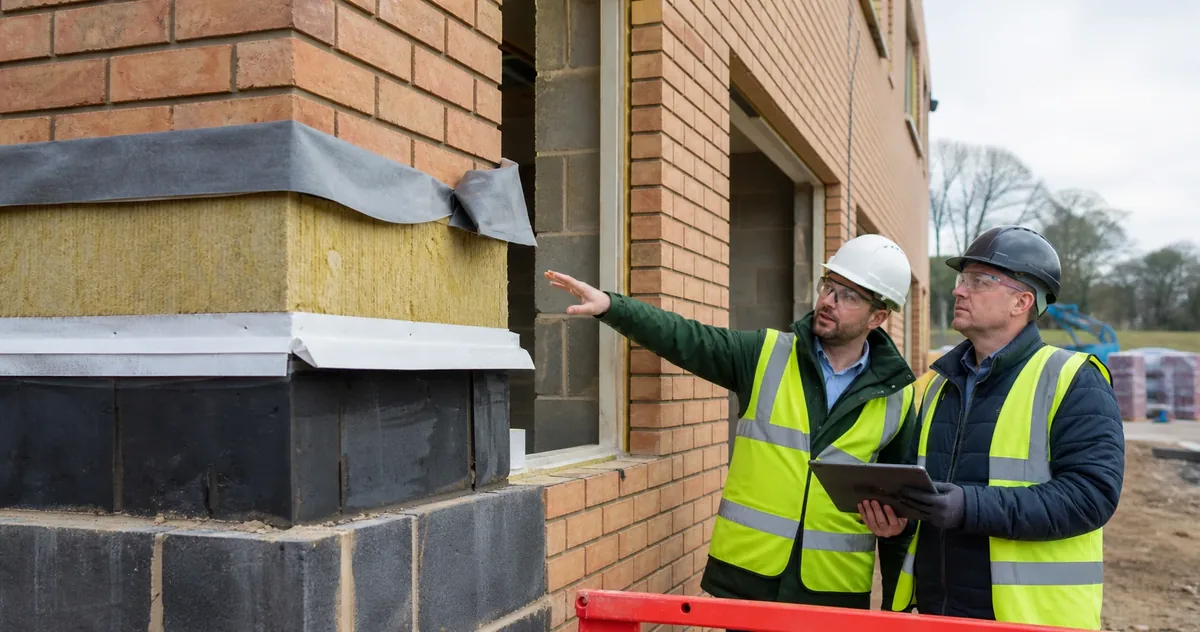
Approved Document L sets out BREL reporting and photographic evidence for relevant new dwellings in England. The exact guidance depends on the regulatory edition and transitional position applying to the building. The principle is consistent: evidence should help the energy assessor and building-control body understand whether the assessed specification has been built. Under the 2021 edition, Appendix B also calls for geolocation to be enabled to record location, date and time, and filenames to identify the plot and detail. It provides for separate assessor and developer signatures on the as-built BREL report. Check the corresponding provisions in the edition applying to the project.
Build the schedule from the BREL information
Start with the design-stage BREL report, construction drawings, junction strategy and product schedule. The evidence plan should use the same plot, element and detail references. If the assessment relies on a particular insulated lintel, thermal-break detail or services product, the site team needs to know before that item is installed.
A generic checklist copied between developments can miss project-specific risks. Apartment blocks, terraces, room-in-roof designs and different foundation systems expose different details at different stages.
Plan around concealment
Foundation and floor-edge insulation, cavity work, lintels, jambs, sills, roof junctions and service penetrations can become hidden within days. Add evidence points to the inspection or quality plan rather than wait for a request from the assessor.
The person taking the photographs does not need to be the energy assessor, but they need clear instructions and a route for checking uncertain details before work is closed.
Make images attributable
Use a consistent file or upload naming rule that includes the site, plot or dwelling, detail reference and date. Include enough visual context to locate the detail. Where a close-up is needed, pair it with a wider image.
Avoid relying only on a whiteboard that obscures the construction. A permanent plot marker, recognisable location or controlled digital record can make attribution stronger, provided the evidence process satisfies the applicable guidance.
Show quality, not just presence
A photograph should reveal insulation continuity and workmanship where that is the purpose of the evidence. Packaging on site does not demonstrate installation. A distant photograph of a wall does not show a cavity closer or reveal a gap around a service.
If the image exposes a defect, fix the work and record the correction. Deleting the first image does not remove the underlying issue from the construction process.
Reconcile change as it occurs
Product and detail changes should be raised with the assessor before the as-built calculation. Evidence is a useful change-control signal: a different block, insulation thickness, window product or heating system may alter model inputs or junction applicability.
At completion, the as-built BREL report, photographs, test results, commissioning information and product confirmations should describe the same dwelling. Unexplained differences create delay and can require new evidence or corrective work.
Set plot and detail references
Align the evidence schedule with the design-stage model, drawings and site quality process.
Brief each trade
Show what must remain visible, how it will be photographed and who reviews uncertainty.
Review continuously
Check images while details remain accessible and return unclear evidence quickly.
Reconcile before completion
Confirm that installed products, photographs, test results and calculation inputs agree.
Frequently asked questions
Can all photographs be taken on one plot?
Do not assume this. The 2021 England guidance states that photographs should be unique to each dwelling. Always follow the edition and project-specific requirements that apply.
Can a supplier delivery note replace a photograph?
It may support product evidence, but it does not normally show that the product was installed correctly in the required location.
What happens if a detail is already covered?
Raise it immediately with the energy assessor and building-control body. Do not fabricate or reuse evidence from another dwelling.